-
New Year Test
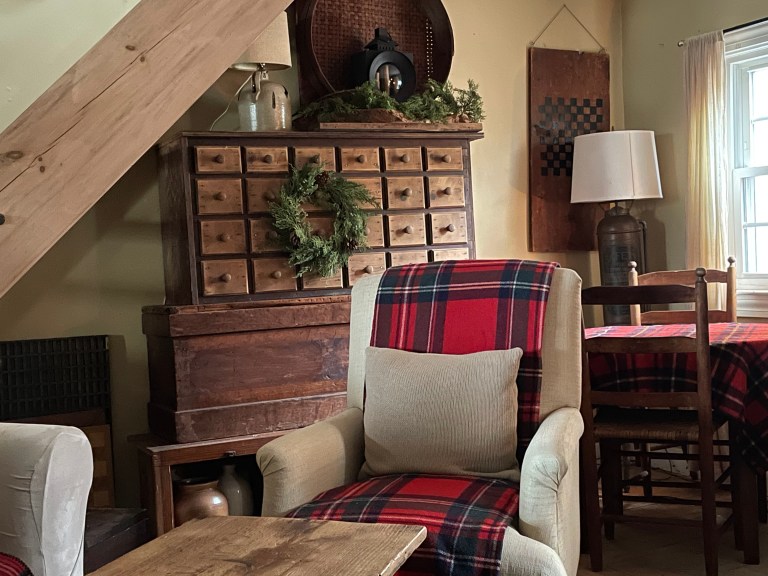
Yes, this is a test as I refamiliarize myself with the CMS for this site. After exploring I will delete the post.
This is just a photo of the Living Room.
-
10 Tips to Know if an Antique Mall is Right For You

Recently I mentioned that I am always on the lookout for prime locations for new shop space. Today I want to discuss what to look for when you, as an aspiring Antique Vendor, are scoping out space in an Antique Mall.
Of all the business models I’ve experimented with, I tend to like the Antique Mall (sometimes called a Group Shop) best. But how does one choose? Here’s what I look for when searching for a new home for my Vendor space.
Antique Shop Owner
I look for a like-minded person who conveys an aura of hospitality. After all, this isn’t just junk. I offer unique artifacts used to create a warm and inviting atmosphere in someone’s home. I look for friendliness, creativity, and enthusiasm. Does the shopkeeper love what she does? Does she appreciate and see the charm of these rusty items, or does she just see a pile of junk for sale? Is the owner hard working?
The owner should be the face of the business, not an absentee landlord. Is she dependable, is she open when she says she’s going to be open? Are the shop hours sufficient to capture impulse shoppers and regulars alike? Is she savvy, fair and trustworthy in business dealings with vendors and customers?
Antique Mall Location
If an antique shop is a destination unto itself, it can reside in the woods, far up a back road. But most shops benefit from high visibility to get their customer traffic. Does the shop you occupy have high visibility and a pleasant outside aesthetic? Does the building have curb appeal? How about adequate parking for vendors to load and unload product, and plenty of space for customers, so they aren’t intimidated by the lack of parking spaces, and keep on driving to another shop a few miles up the road.
Proximity to Home
Ideally your shop space is close enough to home that you can service your space one or two times a week. By that I mean, replenish stock that has left a gaping hole in your displays, or remove an item that has simply taken up space for the past month, with little or no interest from buyers. Sometime it may be to simply “Fluff it up”, because you were driving by.
 You may choose to have more than one antique shop. Presently I have one space 20 minutes from home, and I have another one a half-hour in the opposite direction. This is very manageable, though it would be ideal if they were in the same direction, because I could hit them both in the same day.
There have been times when the ideal store for me has been over an hour drive from home. When business is booming, this is OK, but if business is marginal, a two-hour round trip, gasoline, tolls and more can quickly make the situation intolerable.
Vendor Churn
Visit the shop several times. Observe how many empty spaces there are. How many booths are offering steep discounts, or moving sales? If that number is high, that is not good. Is there a waiting list to get space? If so, that may be a good sign. It means people aren’t eager to leave. Are a disproportionate number of the booths occupied by the owner? If so, it might mean that they can’t satisfy enough vendors to keep them in the shop.
Customer Traffic
We already addressed automotive traffic in the previous section, but what about customer traffic? Is the parking lot always empty when you drive by? When you stop in the store to look around, are you the only customer in the store for 20-30 minutes? If so, beware. The more eyeballs that see your stuff, the better chance you have of selling. If no one’s there, no one’s buying. If you see customers, observe whether they buy, or simply kick the tires and walk out empty-handed.
Days and Hours Open for Business
How many days a week a this antique mall is open for business can vary. Is the shop open on weekends? What time does it open? If it only opens at noon, that might be problematic. Does the shopkeeper view this as a real business (moving inventory and profitability), or is it a hobby (labor of love and a social outlet). I would suggest you don’t want to bet your bottom line with a hobbyist.
In recent years I’ve observed some shop owners strive to create a sense of scarcity, being open only one weekend a month. Yes, two days only. These are marketed as “events”. Such a business model does tend to stimulate a great deal of traffic and shopping activity in a short period of time. However, if you wish to participate in such a venture, there is a great deal of work involved in getting all your product to the shop for two days, and then removing it all to bring back to your own storage for the next 28 days.
Web & Social Media Presence
The olden days of advertising in a monthly regional antique/collectible dealer newspaper are history. Yes, some still exist, but they are expensive, and they are seldom timely. Does your antique mall still send expensive post cards to your mailbox to stick on your fridge to remind you of the big event on Black Friday? Does your shop owner have an e-mail list? Even better – does the shop owner allow you to collect e-mail subscribers within your own booth?
Good shops have a professional Facebook page and manage it daily to keep readers interested in the new arrival of products, and to constantly remind shoppers that cool stuff is “hit or miss”, so you gotta keep on top of things for fear of missing out (FOMO). In addition to Facebook, better shops have their own website, and their own domain. And the best shops use Facebook and their webpage in concert with professional e-mail reminders of special events and to create a tribe of savvy shoppers, who get the news first on new arrivals.
Price Points & Customer Demographics
Some markets cater to a higher-end clientele that have no issue with paying premium pricing. Other markets prefer moderate/fair pricing. Others, are just plain cheap, avoid these at all costs. If a shop is perceived as simply an indoor flea market or yard sale – run! These shoppers place no value on what you have, all they want to do is deal. I could include links to sites or Facebook pages that would illustrate each of these scenarios, but I don’t want the negativity.
Often times this is less a matter of geography and more of a mindset conveyed by the shopkeeper. Which leads to my next point.
Beware of the “Sale Mentality”
Some shop owners think having a “Sale” is the way to drive business. They are eager to promote “Sales” to get buyers into the door, to buy your stuff at a discount. But the shop owner is still getting full price on the rent from all the vendors. Some even expect vendors to be on site to help “man the store”. If you pay rent, then have to discount your products, bake cookies and work at the counter, then I have a cheaper business model for you. Put your stuff on the curb with a “Free Stuff” sign on it. It will be much less work, for the same profit.
Similar Design Aesthetics
If you step into a shop and the booths all look just a little too similar, odds are that the owner is occupying most of the space. If the booths vary in the types of collections and presentations, then this visual diversity suggests many creative vendors are present.
Either way, you want to be in a space with similar quality merchandise. You want variety, yet similar. You want to see merchandise that is clean, gently worn to show its age and character, yet serviceable or displayable.
Summary
There you have it. 10 tips about what I look for when I’m scouting out new antique shop space. These are not hard and fast rules, but they are guidelines that will give you a starting point when you begin exploring antique mall alternatives in your area.
If you have any additional ideas to share, please add them to the comments section below.
If you like this photo and story, please share it with your friends with any of the buttons below.
-
Vintage Metal Flower Cart
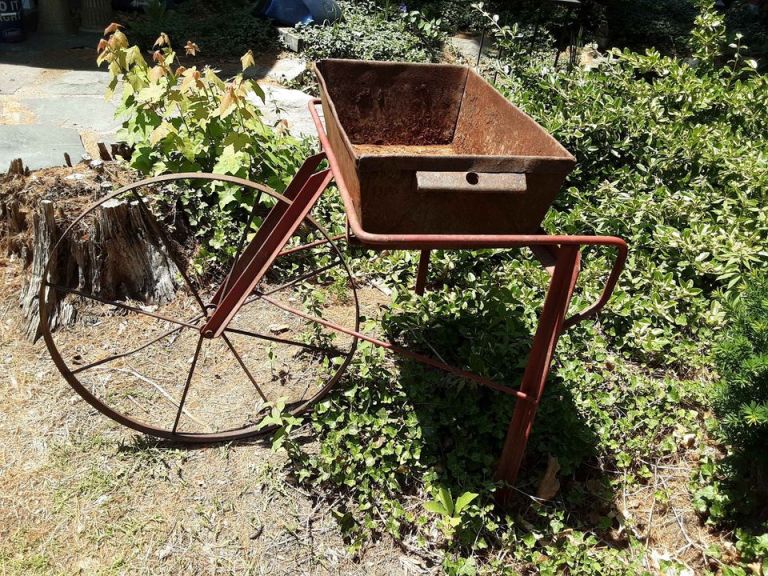
An awesome piece for your garden! Its a vintage flower cart. It is made of metal and has a very rusty container which has holes in the bottom. It is painted a rusty red color. It’s ready for planting. Great focal piece in any garden setting. In good used condition.

Dimensions are 25 by 25. Planter box is 19.5 across by 12.5 wide by 6 deep
Price is 169.00 FIRM NO HOLDS – CASH ONLY – PICKUP IS IN GROTON MA -
Handmade Pine Cupboard
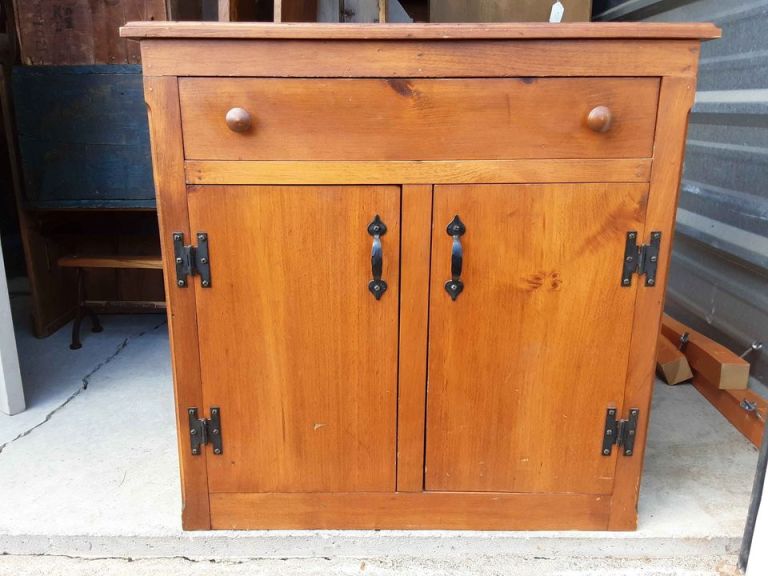
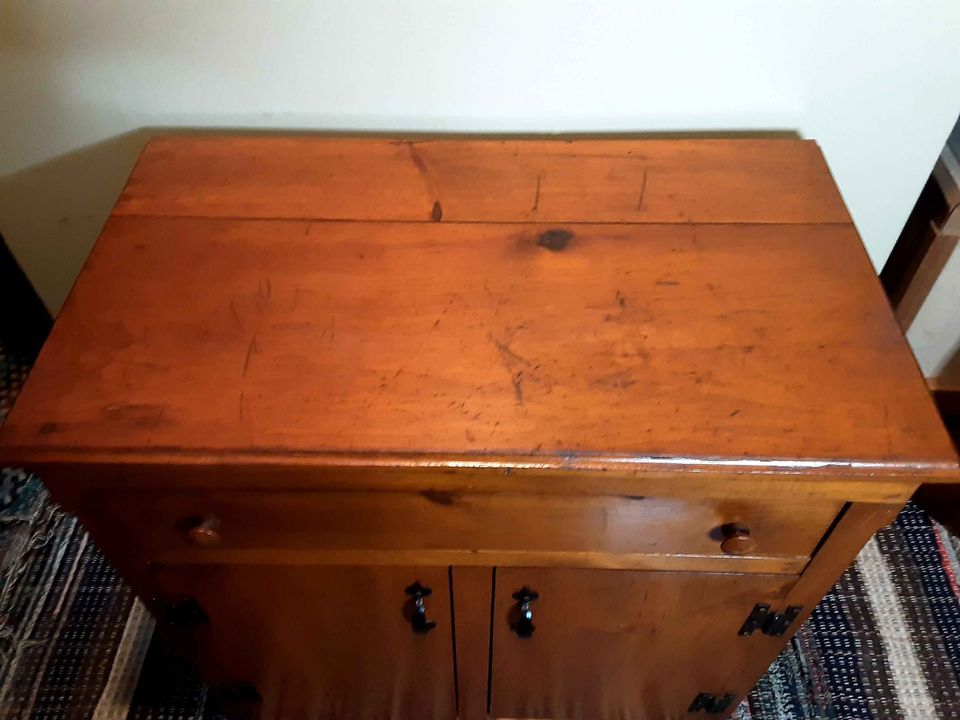
SOLD – a charming small handmade pine cupboard from Dublin NH. Perfect size for a small room and would fit cottage, rustic, or farmhouse decor. It has a drawer and two shelves below for storage. Very sturdy and well made piece. In very good used condition.
Dimensions: 29 inches wide, by 19.5 inches deep, by 29 inches tall.
-
Rough Pine Bench
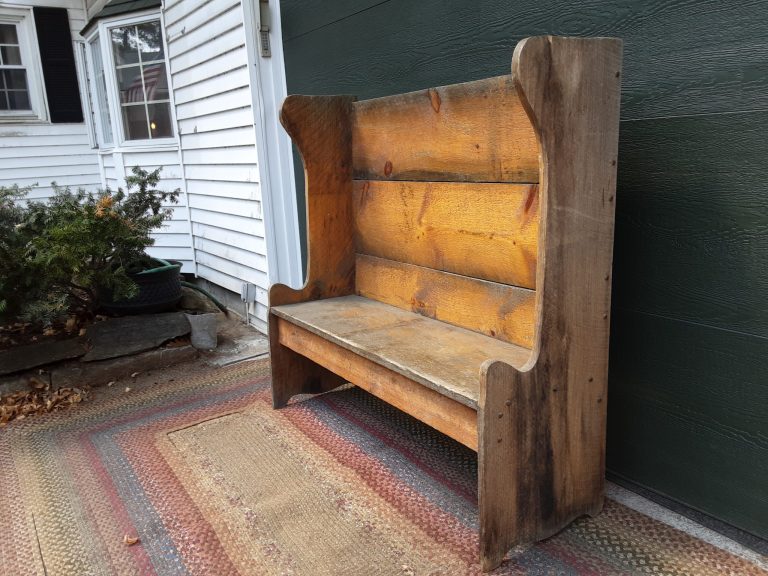
SOLD – A tall rustic pine settle bench for your covered porch. Is made of rough pine and sturdy. Just in time for summer sitting and dining.
It does have an open area below to store baskets or boxes. Dimensions for the bench are 51 inches across, 50 inches tall, and 16 inches deep at the seat.


-
The Road Not Taken?
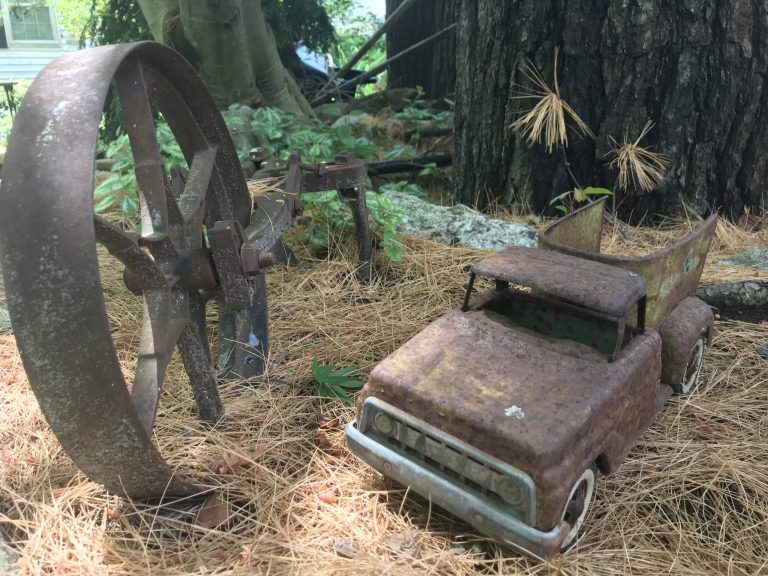
A Poem and More…
The Road Not Taken is perhaps my favorite poem by Robert Frost. In addition to its pleasing rhythm and rhyme, I love its ability to create a realistic image of nature and the passing of time, a lifetime, in my mind’s eye.
In the poem Frost extols on how the path he has chosen has played such a significant role in how his life has evolved. It doesn’t appear that he ever looked back, or questioned his choice. In fact, the last three lines of the third stanza say:
Oh, I kept the first for another day!
Robert Frost – The Road Not Taken
Yet knowing how way leads on to way,
I doubted if I should ever come back.By the end of the poem, we know for a fact that the narrator, never did revisit his decision and take the other path.
In life we are all forced to make choices, either actively or passively, by omission or by commission. Sometimes we are right, other times we are wrong. Sometimes we have the opportunity for a “do-over” and we are blessed with a viable mid-course correction. Sometimes we simply make our bed and sleep in it.
The Road to Suzanne’s Cottage
Revisiting my path, that is what today’s essay is about. You may call it a mid-course correction, or even a sabbatical. Either way, I am eager to break free from the path I am currently on.
This road began when I was first married, a half-century ago. We scrounged to collect furniture and accessories for our first apartments, and eventually our own home. Eventually we were able to afford “real furniture”, you know, from a real furniture store. Yes, it looked very nice, but…
…but it had no character, no patina, no history. Simply stated it didn’t tell a story and it added no life to our home. So we went back to hunting for stuff that we liked, stuff that was old, that had survived decades of abuse and dozens of children. Yes, we now were buying used stuff because we wanted to, not because we had to.
Need Evolved into Obsession
By the time we had adequately furnished our home, we had frequently visited the Brimfield Flea Market, Hollis Flea Market, Amherst Flea Market, Westford Flea Market, and dozens of Antiques Shops. So we kept finding unique items with which to furnish our home. What had begun as simple bargain hunting evolved into a passion. It was the “thrill of the hunt”.
Now we are at a point in our lives where we are 1) divesting many of our collections, and 2) flipping bargains that still come our way. That is what drove me to becoming a picker/vendor at many antique shops in the region over the years.
Times Change
Over the past decade I have tracked monthly sales and I have been able to predict seasonal trends for my particular area in New England. For example Summer is slow because Antique Mall spaces are competing with Flea Markets, Town Wide Yard Sales, Church Fairs, in addition to the ever-increasing internet channels like Craigslist, Facebook Marketplace, Etsy, etc. I call it the Summer Doldrums.
Conversely after Labor Day things begin to improve. When the frost is in the air, and people break out their sweaters and their Uggs, people come out to shop for home. I call it the Nesting Season. People like old wooden furnishing and unique accessories to make their home cozy for the winter months.
November has typically been my best month, December is less, January has a brief spike in sales. Then things slow down as heating bills and credit card bills from the holidays shift household spending priorities.
This cycle has been predictable for me for years, until 2020. The lock downs and all Covid related disruptions rattled any predictability. Things are getting back to normal in the US, but I place little stock in being able to predict what the year 2021 will bring for sales in my Antique Mall shop space.
May 2021 Experiment
During lockdown I began using the Facebook Marketplace with a moderate amount of success, directing all traffic to my shop space at an Antiques Mall. However, over the past six-months shop sales have declined precipitously, for reasons beyond my control. So for the month of May I decided to perform a test.
Instead of directing traffic to the store, I decided to do all Facebook Marketplace “off my tailgate.” My Facebook Marketplace sales would all be for pick-up at a public location, a small shopping plaza near my home. Ironically, the items that sold the quickest had been in my shop for months, with no takers. When I moved them back home, I posted on the Marketplace and sold the items within a week.
After a full month, I compared my receipts. My “Tailgate” money was only $100 less than my fancy shop space. BUT the Tailgate sales had no commissions, fees or overpriced rent. And the Tailgate Sales were only five minutes from home, versus the shop which is 50-minutes away.
I moved many nice pieces for my full asking price, after they had been languishing in the store for months, even with discounted prices. In addition to higher-priced sales, I had No Rent. No Commission. No additional Fees. No driving back and forth for hours every week.
Suzanne’s Road Not Taken -Part II
The character in Robert Frost’s poem did not reconsider his path. He did not go back into the yellow wood to take the first path to see where it goes. But I did. It makes no sense for me to continue down this path. Renting shop space where goods are not moving, is simply paying for overpriced storage.
For the next several months, and possibly beyond, I am relinquishing any rented shop spaces, unearned commissions, incremental fees, etc. Instead I will do all my trading in person. I expect fewer items to be sold, and less gross sales, but this will be offset my reduced expenses and 10-20 hours per week recovered. It seems like a good trade to me. Expect an update as I explore this new road. Trust me to give you the Good, the Bad, and the Ugly.
If you like this photo and story, please share it with your friends with any of the buttons below.
-
Vintage Clement Rocker
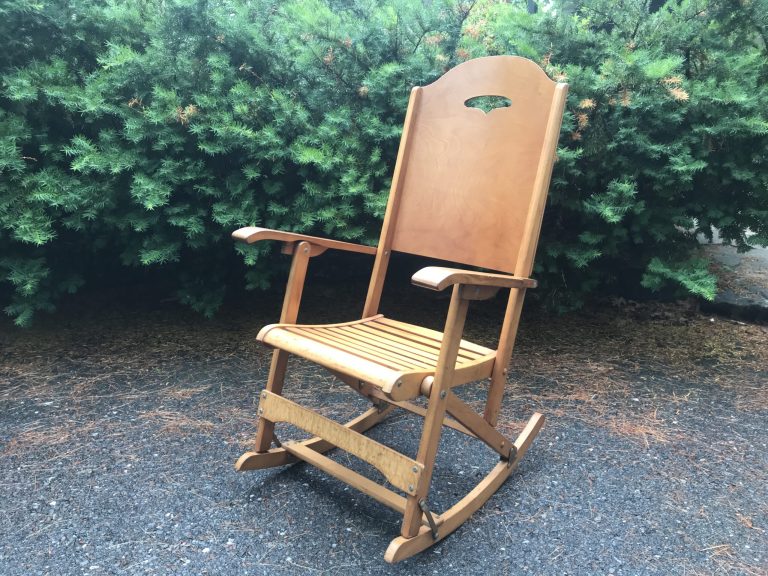
SOLD – A vintage folding rocking chair by Les Freres Clement (Clement Brothers) of Quebec. The chair is solid maple and it folds up nicely to stow away anywhere. This compact, portable rocker is ideal chair for home or your cabin. It’s quite comfortable, so set by the fireplace and relax with the beverage of your choice.
-
Decorating with Wooden Balls
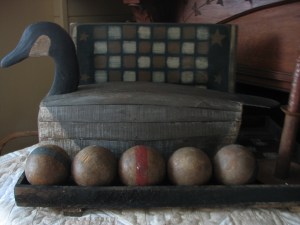 A Ball by any Other Name
Guess what this post is about? Would you believe, it’s about spheres. OK, it’s balls. More specifically, it is about using them in decorating.
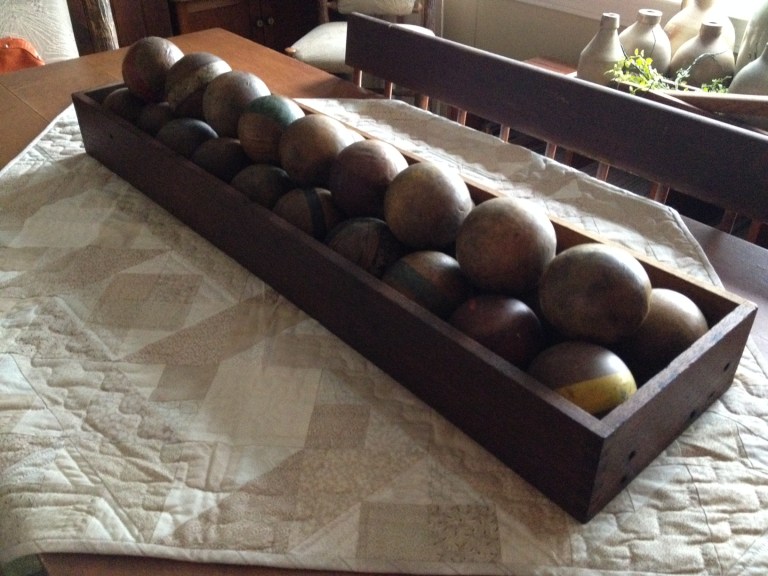
I love to fill boxes and bowls with them, and I love how the light plays on their curves. Whatever you choose to call them, round items are popular design elements in my home.
Nothing Shiny
Enter the term “decorative balls” into your web browser and you will be bombarded with glass, textile, metal, disco-mirror, rag, rope, feathers and a gazillion other round design elements. The displays are also quite varied, such as being placed in large glass cookie jars and vases, wire baskets, and upon pedestals. Many are brightly colored and shiny.
At Suzanne’s Cottage, we don’t do “shiny”. My color palette tends to be more subdued and earthy. Instead of brightly colored glass, or shiny metal, I have Croquet balls, Bocce balls, Billiard balls, Baseballs, and Softballs.
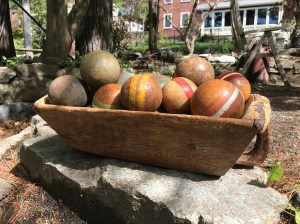 They are easy to find. I get them at yard sales, swap sheds, flea markets. People throw them away. People give them to me.
I soften their appearance by staining them. It dulls what may be left of bright stripes painted on the balls. It also helps them to blend with their wooden containers. This works with wooden balls and hide covered balls like baseballs. This link will illustrate how they often appear in my home.
Obviously billiard balls will remain unstained, so rather than blending, their polish and brightness offer contrast in their displays.
Display Alternatives
Most of my display containers tend to be wood. This house screams “brown” louder than a UPS Truck. I accessorize with color, but at the heart of it, earth tones rule.
So my various round collections will be displayed in wooden bowls, boxes, baskets (my husband will be proud of my use of alliteration). I also use trays and crockery to add variations in color and texture.
Nothing says Spring quite like a large wooden bowl of baseballs on the table. Well, actually a vase of daffodils or tulips works too.
If you like this photo and story, please share it with your friends with any of the buttons below.
-
Vintage Mahogany Gateleg Table
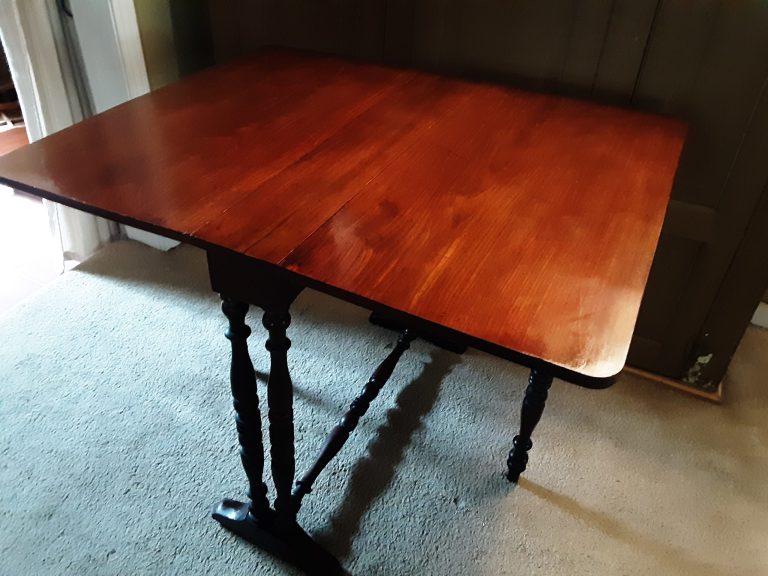
SOLD – a small profile mahogany gateleg table. Perfect for a small space when not needed. Closed it measure only 6 .5 inches and expands to 38 inches when the two leaves are fully extended. It is 29 inches high by 31 deep. It is in good used condition.


-
Hand Painted Pine Trunk
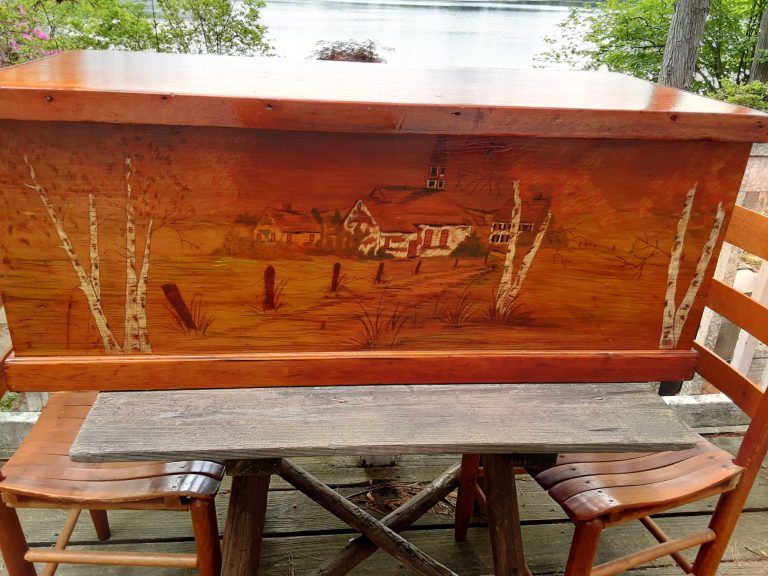
SOLD – a hand painted, handmade pine storage trunk. Great piece to use as a coffee table or extra storage for out of season items. Would fit nicely in a lake or camp house as it is rustic. It has two handles so is also easy to move around. Note, the lid is not attached but the hardware is include to do so.
Dimensions are 36 long, by 16 wide, by 15 deep on the outside, and 13 deep on the inside.


 Suzanne's Cottage