-
New Year Test
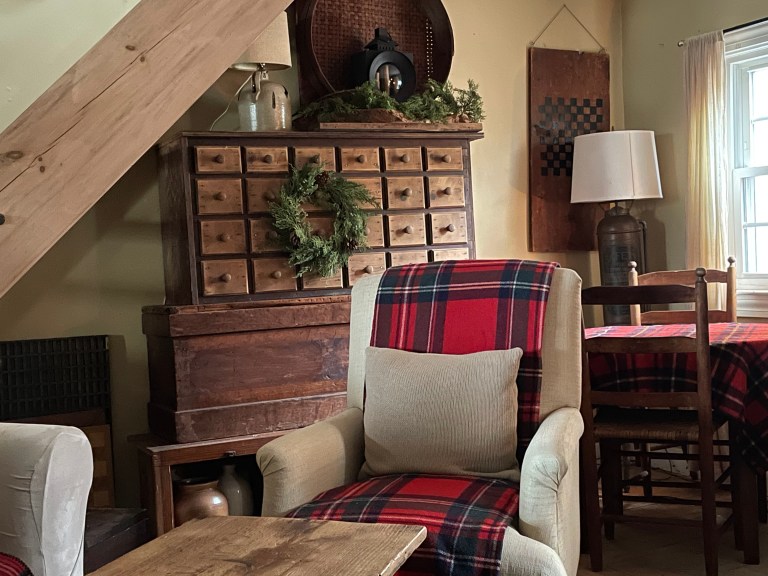
Yes, this is a test as I refamiliarize myself with the CMS for this site. After exploring I will delete the post.
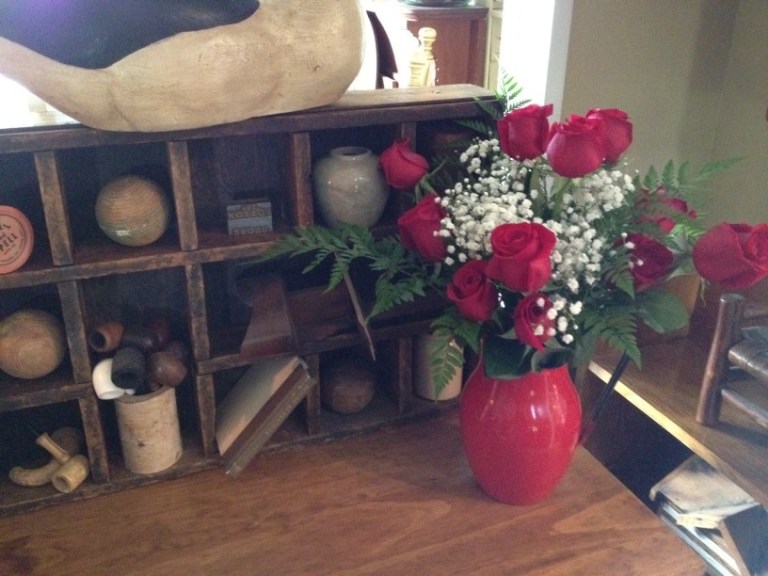
This is just a photo of the Living Room.
-
10 Tips to Know if an Antique Mall is Right For You

Recently I mentioned that I am always on the lookout for prime locations for new shop space. Today I want to discuss what to look for when you, as an aspiring Antique Vendor, are scoping out space in an Antique Mall.
Of all the business models I’ve experimented with, I tend to like the Antique Mall (sometimes called a Group Shop) best. But how does one choose? Here’s what I look for when searching for a new home for my Vendor space.
Antique Shop Owner
I look for a like-minded person who conveys an aura of hospitality. After all, this isn’t just junk. I offer unique artifacts used to create a warm and inviting atmosphere in someone’s home. I look for friendliness, creativity, and enthusiasm. Does the shopkeeper love what she does? Does she appreciate and see the charm of these rusty items, or does she just see a pile of junk for sale? Is the owner hard working?
The owner should be the face of the business, not an absentee landlord. Is she dependable, is she open when she says she’s going to be open? Are the shop hours sufficient to capture impulse shoppers and regulars alike? Is she savvy, fair and trustworthy in business dealings with vendors and customers?
Antique Mall Location
If an antique shop is a destination unto itself, it can reside in the woods, far up a back road. But most shops benefit from high visibility to get their customer traffic. Does the shop you occupy have high visibility and a pleasant outside aesthetic? Does the building have curb appeal? How about adequate parking for vendors to load and unload product, and plenty of space for customers, so they aren’t intimidated by the lack of parking spaces, and keep on driving to another shop a few miles up the road.
Proximity to Home
Ideally your shop space is close enough to home that you can service your space one or two times a week. By that I mean, replenish stock that has left a gaping hole in your displays, or remove an item that has simply taken up space for the past month, with little or no interest from buyers. Sometime it may be to simply “Fluff it up”, because you were driving by.
 You may choose to have more than one antique shop. Presently I have one space 20 minutes from home, and I have another one a half-hour in the opposite direction. This is very manageable, though it would be ideal if they were in the same direction, because I could hit them both in the same day.
There have been times when the ideal store for me has been over an hour drive from home. When business is booming, this is OK, but if business is marginal, a two-hour round trip, gasoline, tolls and more can quickly make the situation intolerable.
Vendor Churn
Visit the shop several times. Observe how many empty spaces there are. How many booths are offering steep discounts, or moving sales? If that number is high, that is not good. Is there a waiting list to get space? If so, that may be a good sign. It means people aren’t eager to leave. Are a disproportionate number of the booths occupied by the owner? If so, it might mean that they can’t satisfy enough vendors to keep them in the shop.
Customer Traffic
We already addressed automotive traffic in the previous section, but what about customer traffic? Is the parking lot always empty when you drive by? When you stop in the store to look around, are you the only customer in the store for 20-30 minutes? If so, beware. The more eyeballs that see your stuff, the better chance you have of selling. If no one’s there, no one’s buying. If you see customers, observe whether they buy, or simply kick the tires and walk out empty-handed.
Days and Hours Open for Business
How many days a week a this antique mall is open for business can vary. Is the shop open on weekends? What time does it open? If it only opens at noon, that might be problematic. Does the shopkeeper view this as a real business (moving inventory and profitability), or is it a hobby (labor of love and a social outlet). I would suggest you don’t want to bet your bottom line with a hobbyist.
In recent years I’ve observed some shop owners strive to create a sense of scarcity, being open only one weekend a month. Yes, two days only. These are marketed as “events”. Such a business model does tend to stimulate a great deal of traffic and shopping activity in a short period of time. However, if you wish to participate in such a venture, there is a great deal of work involved in getting all your product to the shop for two days, and then removing it all to bring back to your own storage for the next 28 days.
Web & Social Media Presence
The olden days of advertising in a monthly regional antique/collectible dealer newspaper are history. Yes, some still exist, but they are expensive, and they are seldom timely. Does your antique mall still send expensive post cards to your mailbox to stick on your fridge to remind you of the big event on Black Friday? Does your shop owner have an e-mail list? Even better – does the shop owner allow you to collect e-mail subscribers within your own booth?
Good shops have a professional Facebook page and manage it daily to keep readers interested in the new arrival of products, and to constantly remind shoppers that cool stuff is “hit or miss”, so you gotta keep on top of things for fear of missing out (FOMO). In addition to Facebook, better shops have their own website, and their own domain. And the best shops use Facebook and their webpage in concert with professional e-mail reminders of special events and to create a tribe of savvy shoppers, who get the news first on new arrivals.
Price Points & Customer Demographics
Some markets cater to a higher-end clientele that have no issue with paying premium pricing. Other markets prefer moderate/fair pricing. Others, are just plain cheap, avoid these at all costs. If a shop is perceived as simply an indoor flea market or yard sale – run! These shoppers place no value on what you have, all they want to do is deal. I could include links to sites or Facebook pages that would illustrate each of these scenarios, but I don’t want the negativity.
Often times this is less a matter of geography and more of a mindset conveyed by the shopkeeper. Which leads to my next point.
Beware of the “Sale Mentality”
Some shop owners think having a “Sale” is the way to drive business. They are eager to promote “Sales” to get buyers into the door, to buy your stuff at a discount. But the shop owner is still getting full price on the rent from all the vendors. Some even expect vendors to be on site to help “man the store”. If you pay rent, then have to discount your products, bake cookies and work at the counter, then I have a cheaper business model for you. Put your stuff on the curb with a “Free Stuff” sign on it. It will be much less work, for the same profit.
Similar Design Aesthetics
If you step into a shop and the booths all look just a little too similar, odds are that the owner is occupying most of the space. If the booths vary in the types of collections and presentations, then this visual diversity suggests many creative vendors are present.
Either way, you want to be in a space with similar quality merchandise. You want variety, yet similar. You want to see merchandise that is clean, gently worn to show its age and character, yet serviceable or displayable.
Summary
There you have it. 10 tips about what I look for when I’m scouting out new antique shop space. These are not hard and fast rules, but they are guidelines that will give you a starting point when you begin exploring antique mall alternatives in your area.
If you have any additional ideas to share, please add them to the comments section below.
If you like this photo and story, please share it with your friends with any of the buttons below.
-
Cottage Cubism
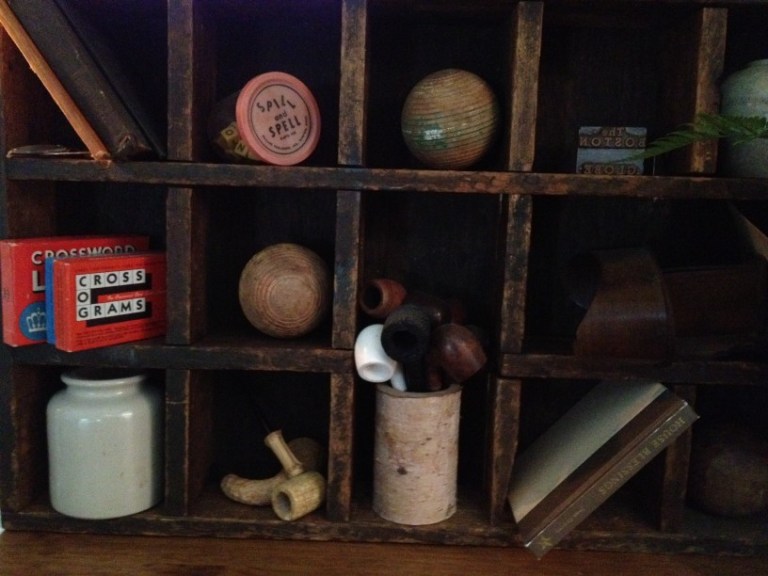
Suzanne and Picasso view Cubism differently.
I love to play with shapes and collections. If you look around the cottage you will see collections everywhere. These include crockery, balls & spheres, game boards and rolling pins, just for a start.
This box itself is a collection of boxes. It is old pine and it is really beat up. It has a lot of character. When I saw it at the old Bernat Mill a long time ago, I knew exactly how I wanted to use it at home. I would use it for a collection of “smalls”. Since each cube is only fives inches square internally, they are small “smalls”.
The items are fun things like little pocket games from the thirties, old pipes like my grandfather used to smoke, croquet balls, eyeglasses from back in the day when glasses were made from glass, etc. Well that’s what’s in the cubes today, God only knows what will be there in July.
-
The Cinder Block Sofa
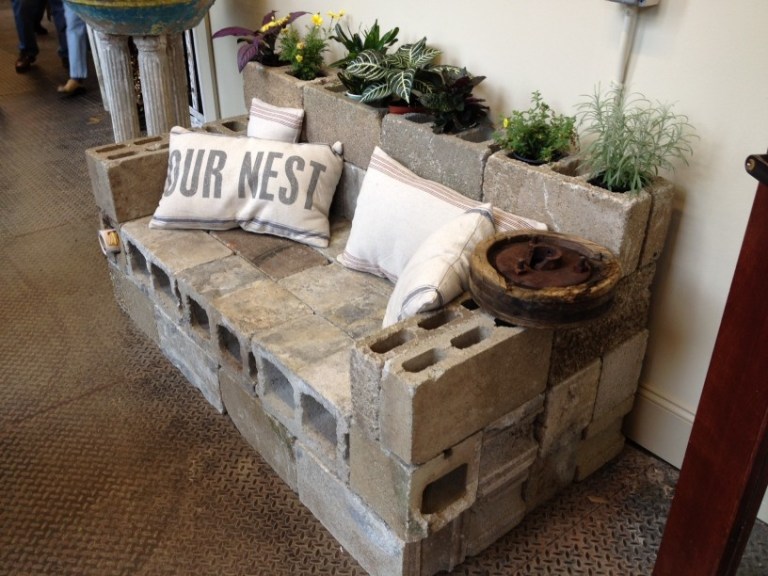
On Saturday Charles drove me to the grand opening of Mill City Antiques in Manchester, New Hampshire. The shop is located in a renovated mill building on the Merrimack River. The building is magnificent and the shop is wonderful.
We live in Massachusetts, an hour south of Manchester, yet the first booth I walked into I was greeted with a hug by a lady I know from another Manchester shop on Elm Street. I was in my element. Old friends and old treasures surrounded me.
When we entered the shop, this Cinder Block Sofa was by the door. Charles was quite fascinated with it. He imagined how cool it would be in the garden, with every hole stuffed with soil and plants. He is pondering the viability of building one at our cottage. The challenge – our narrow lot. We live on a long and narrow lot with no room for even a lawn tractor on either side of the cottage.
If Charles is nice maybe one of the neighbors would permit him to back his truck down to the backyard on their lawn. Otherwise every block has to be carried 150 feet to the back. After lugging all this material that far, perhaps Charles will be tired enough that he could take a nap – even on a cement couch.
-
My Bargain Wicker Rocker
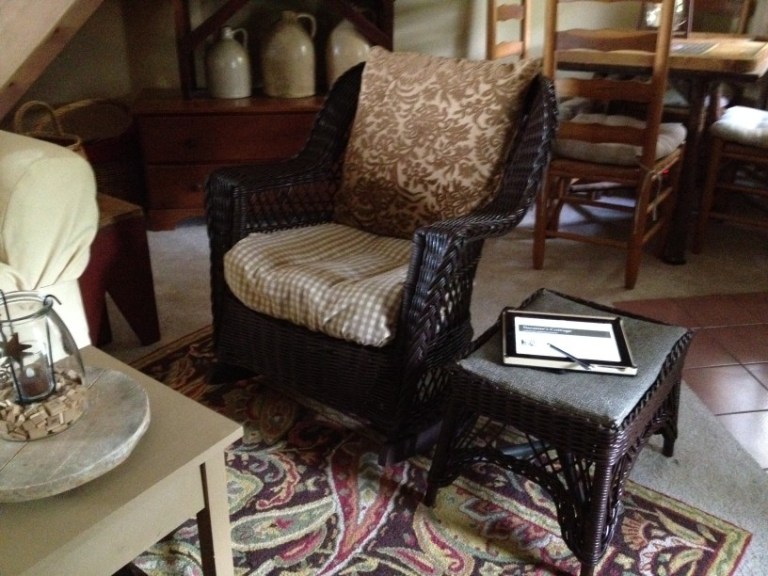
When I was at Brimfield a few weeks ago, I saw a wicker rocking chair that caught my eye. It was solid, but it needed some cosmetic work. They wanted $150 so I walked away, with my wallet intact.
Last week I stopped by a yard sale and there was a nicer wicker rocker for $10! Yes, you read that correctly. I snatched it up and threw it in my car, thrilled about my bargain.
When I got home I showed it to Charles and he offered to paint it for me if I went to Lowes to buy the paint. Remember the paint I mentioned in the Mountain Laurel post? I also had a wicker footstool I had picked up ages ago for $20. So with paint, old cushions and fabric that I had on hand, my wicker ensemble cost me less than $50! I’m excited.
-
Happy Birthday Suzanne
Today is Suzanne’s birthday. Happy Birthday Sweetie!
I am sneaking this post into her website to wish her a very Happy Birthday, and to let everyone else know to send her birthday greetings. I will not reveal her age because I would like to live to have another birthday of my own.
Regards,
Charles -
Mountain Laurel

When we moved to the cottage 8 years ago, it was covered with magnificent blooms of Rhododendrons and Azaleas. The problem was that none of them had been cut back or trained. So they had grown wild and leggy and pruning was not going to retrain 20-years of unbridled growth.
So we removed most of them, except the ones that could be salvaged and cut back. That left some big holes to fill.
Over the past years we have filled in a great deal and the house is much more open to the street. It is less like a jungle fortress and the curb appeal is much more welcoming to the neighborhood.
Two weeks ago, Charles and I were walking around surveying the blooming Rhodos and I commented to him that I wanted some Mountain Laurels to fill in a few areas where we needed bushes for privacy, color and texture. So last week I went to Lowe’s to get a couple cans of spray paint for another project and I walked through the garden section. There were pallets of Mountain Laurel. They had lost their flowers and they had been marked down from $28 to $4. So I filled up my car with ten bushes.
When I arrived home, Charles was in the garage working on another project. I told him I needed help unloading my car. “How much work can it be unloading two cans of spray paint?” he said. He can be so naive sometimes.
-
You’ve heard of a Hamster Wheel

Yes, we’ve all seen hamster wheels of some sort, whether it be the old-fashioned wire wheel, or the new-fangled plastic balls. This little critter couldn’t be bothered with such nonsense. When he wants a real workout he takes a spin on the old tool sharpener in the garden. He must be on steroids to turn that thing.
Typically our yard is a speedway for scurrying chipmunks. But this year the Chippy population is down. Someone told me that the snowless winter may have killed off a lot of the little rodents, since they had no insulation to protect their burrows. Fact or fiction? Your guess is as good as mine, but I know we have substantially fewer chippies and squirrels this spring.
Regardless of the toll this past winter may have had on our mini-rodents, this scene captivated Charles as he left for work one morning. He whipped out his “life-line”, my nickname for his inseparable iPhone, and he captured this little guy on his sunny garden perch.

 Suzanne's Cottage