-
New Year Test
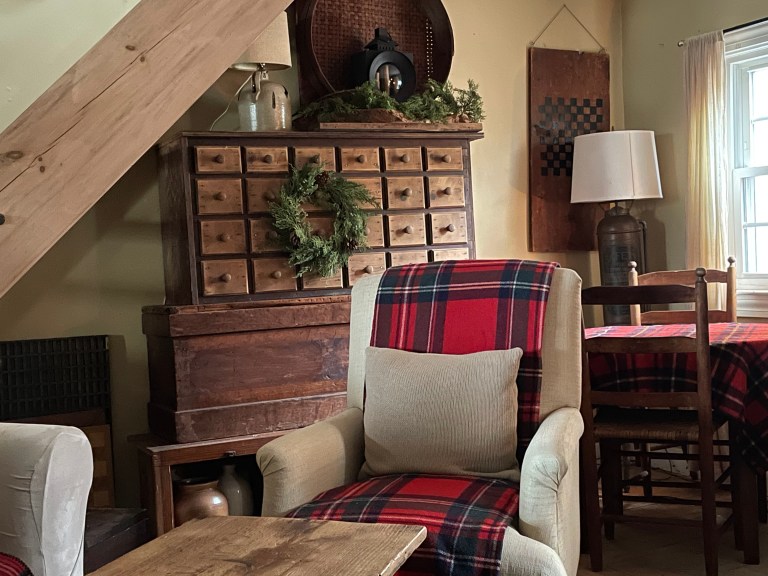
Yes, this is a test as I refamiliarize myself with the CMS for this site. After exploring I will delete the post.
This is just a photo of the Living Room.
-
10 Tips to Know if an Antique Mall is Right For You

Recently I mentioned that I am always on the lookout for prime locations for new shop space. Today I want to discuss what to look for when you, as an aspiring Antique Vendor, are scoping out space in an Antique Mall.
Of all the business models I’ve experimented with, I tend to like the Antique Mall (sometimes called a Group Shop) best. But how does one choose? Here’s what I look for when searching for a new home for my Vendor space.
Antique Shop Owner
I look for a like-minded person who conveys an aura of hospitality. After all, this isn’t just junk. I offer unique artifacts used to create a warm and inviting atmosphere in someone’s home. I look for friendliness, creativity, and enthusiasm. Does the shopkeeper love what she does? Does she appreciate and see the charm of these rusty items, or does she just see a pile of junk for sale? Is the owner hard working?
The owner should be the face of the business, not an absentee landlord. Is she dependable, is she open when she says she’s going to be open? Are the shop hours sufficient to capture impulse shoppers and regulars alike? Is she savvy, fair and trustworthy in business dealings with vendors and customers?
Antique Mall Location
If an antique shop is a destination unto itself, it can reside in the woods, far up a back road. But most shops benefit from high visibility to get their customer traffic. Does the shop you occupy have high visibility and a pleasant outside aesthetic? Does the building have curb appeal? How about adequate parking for vendors to load and unload product, and plenty of space for customers, so they aren’t intimidated by the lack of parking spaces, and keep on driving to another shop a few miles up the road.
Proximity to Home
Ideally your shop space is close enough to home that you can service your space one or two times a week. By that I mean, replenish stock that has left a gaping hole in your displays, or remove an item that has simply taken up space for the past month, with little or no interest from buyers. Sometime it may be to simply “Fluff it up”, because you were driving by.
 You may choose to have more than one antique shop. Presently I have one space 20 minutes from home, and I have another one a half-hour in the opposite direction. This is very manageable, though it would be ideal if they were in the same direction, because I could hit them both in the same day.
There have been times when the ideal store for me has been over an hour drive from home. When business is booming, this is OK, but if business is marginal, a two-hour round trip, gasoline, tolls and more can quickly make the situation intolerable.
Vendor Churn
Visit the shop several times. Observe how many empty spaces there are. How many booths are offering steep discounts, or moving sales? If that number is high, that is not good. Is there a waiting list to get space? If so, that may be a good sign. It means people aren’t eager to leave. Are a disproportionate number of the booths occupied by the owner? If so, it might mean that they can’t satisfy enough vendors to keep them in the shop.
Customer Traffic
We already addressed automotive traffic in the previous section, but what about customer traffic? Is the parking lot always empty when you drive by? When you stop in the store to look around, are you the only customer in the store for 20-30 minutes? If so, beware. The more eyeballs that see your stuff, the better chance you have of selling. If no one’s there, no one’s buying. If you see customers, observe whether they buy, or simply kick the tires and walk out empty-handed.
Days and Hours Open for Business
How many days a week a this antique mall is open for business can vary. Is the shop open on weekends? What time does it open? If it only opens at noon, that might be problematic. Does the shopkeeper view this as a real business (moving inventory and profitability), or is it a hobby (labor of love and a social outlet). I would suggest you don’t want to bet your bottom line with a hobbyist.
In recent years I’ve observed some shop owners strive to create a sense of scarcity, being open only one weekend a month. Yes, two days only. These are marketed as “events”. Such a business model does tend to stimulate a great deal of traffic and shopping activity in a short period of time. However, if you wish to participate in such a venture, there is a great deal of work involved in getting all your product to the shop for two days, and then removing it all to bring back to your own storage for the next 28 days.
Web & Social Media Presence
The olden days of advertising in a monthly regional antique/collectible dealer newspaper are history. Yes, some still exist, but they are expensive, and they are seldom timely. Does your antique mall still send expensive post cards to your mailbox to stick on your fridge to remind you of the big event on Black Friday? Does your shop owner have an e-mail list? Even better – does the shop owner allow you to collect e-mail subscribers within your own booth?
Good shops have a professional Facebook page and manage it daily to keep readers interested in the new arrival of products, and to constantly remind shoppers that cool stuff is “hit or miss”, so you gotta keep on top of things for fear of missing out (FOMO). In addition to Facebook, better shops have their own website, and their own domain. And the best shops use Facebook and their webpage in concert with professional e-mail reminders of special events and to create a tribe of savvy shoppers, who get the news first on new arrivals.
Price Points & Customer Demographics
Some markets cater to a higher-end clientele that have no issue with paying premium pricing. Other markets prefer moderate/fair pricing. Others, are just plain cheap, avoid these at all costs. If a shop is perceived as simply an indoor flea market or yard sale – run! These shoppers place no value on what you have, all they want to do is deal. I could include links to sites or Facebook pages that would illustrate each of these scenarios, but I don’t want the negativity.
Often times this is less a matter of geography and more of a mindset conveyed by the shopkeeper. Which leads to my next point.
Beware of the “Sale Mentality”
Some shop owners think having a “Sale” is the way to drive business. They are eager to promote “Sales” to get buyers into the door, to buy your stuff at a discount. But the shop owner is still getting full price on the rent from all the vendors. Some even expect vendors to be on site to help “man the store”. If you pay rent, then have to discount your products, bake cookies and work at the counter, then I have a cheaper business model for you. Put your stuff on the curb with a “Free Stuff” sign on it. It will be much less work, for the same profit.
Similar Design Aesthetics
If you step into a shop and the booths all look just a little too similar, odds are that the owner is occupying most of the space. If the booths vary in the types of collections and presentations, then this visual diversity suggests many creative vendors are present.
Either way, you want to be in a space with similar quality merchandise. You want variety, yet similar. You want to see merchandise that is clean, gently worn to show its age and character, yet serviceable or displayable.
Summary
There you have it. 10 tips about what I look for when I’m scouting out new antique shop space. These are not hard and fast rules, but they are guidelines that will give you a starting point when you begin exploring antique mall alternatives in your area.
If you have any additional ideas to share, please add them to the comments section below.
If you like this photo and story, please share it with your friends with any of the buttons below.
-
Stoneware Week – Day 3

The Tour
This room is filled with stoneware. This scene is shot in what I call the Gathering Room. It used to be a small bedroom, but I repurposed it into small living room.
Charles removed the inadequate closet, and used standard kitchen cabinets to create a “built-in” entertainment system. A small sectional sofa provides seating for television viewing and conversation. There are no other televisions in the house.
Stoneware
The predominant item in the top photograph is the nice old bead board pine cupboard. I removed the door, (I use it as a decorative element elsewhere in the house) and I filled the shelves with jugs, game boards, small lamps, decoys, books and of course more jugs.
But all your stone crockery doesn’t have to be old to be decorative. Check out the photo below, taken of the other side of the same room. We focused on placing items of like coloration and similar scale, as a collection. Clearly the size was dictated by the form factor of the primitive shelf. So a few newly minted jugs seemed to fit the bill.

This shelf provides great space for featuring collections The whole point of this series is to illustrate that your collections can be displayed prominently throughout your home. When you do it well, these items will integrate into the overall decor, and not shout out, “Hey look at me! I’m a collection!” No, they’ll simply be. And they will blend harmoniously with the other items in the room.
Other simple uses for jugs are door stops or lamps. One of my favorite uses for some of these containers is for vases. Perhaps I’ll do another series on repurposed items to use as unusual vases in the near future. Have fun and thanks for dropping by.
If you like this photo and story, please share it with your friends with any of the buttons below.
-
Stoneware Week – Day 2
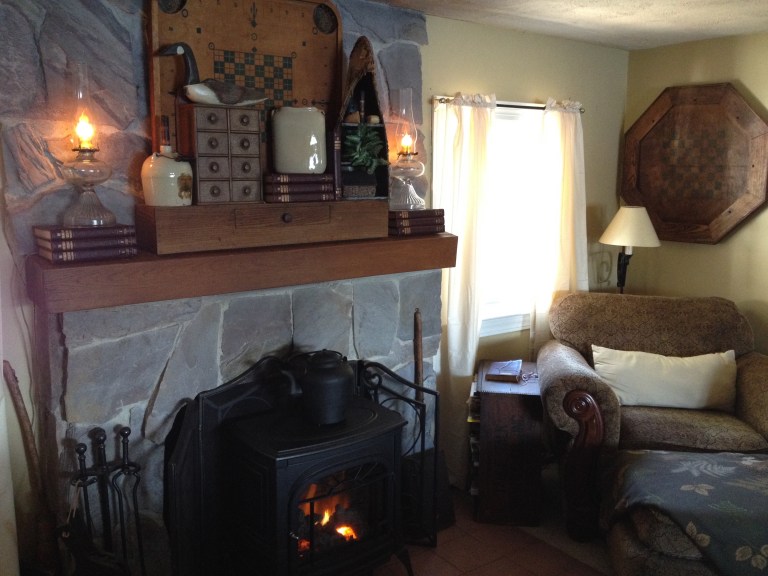
Welcome to the second day, traveling through the cottage in search of stoneware items. Though they abound in other areas of this room, this photo features two.
A Brief Tour
This fireplace is part of the original section of the cottage, which was built in 1900. The fireplace and chimney are actually on the outside wall of the house. It is cold and inefficient. So we have closed the damper, and use the fireplace as a decorative focal point of the room.
This room has relatively low ceilings, and this mantle bisects the vertical space. This mantle changes dramatically from season to season.
In this presentation of the mantle decorations the main focus is on the game board, and all other items are in support of a visual element.
Stoneware
When I cluster together various items such as these, Charles often refers to them as vignettes. Two stoneware items are used as part of the layering in this particular vignette.
On the left is a very squat jug that had an old printed paper label on it that said, “Old Fashioned Maple Syrup”. I just brought the jug to the shop.
More fascinating item is the one the right. It was a large foot warmer, or perhaps a water bottle. It was tall, wide and only about 3 inches thick. At the top, there were ears that held the wire bail with the wooden handle. It always amazed me, that is old is this item was, those small clay ears still remained intact.
We have had many of the cylindrical stoneware hot water bottles, we refer to them as “pigs”, because the ends remind us of a pig nose. But we haven’t seen many of the flat hot water bottles. I was able to locate one online that was similar.
If you like this photo and story, please share it with your friends with any of the buttons below.
-
Stoneware Week – Day 1
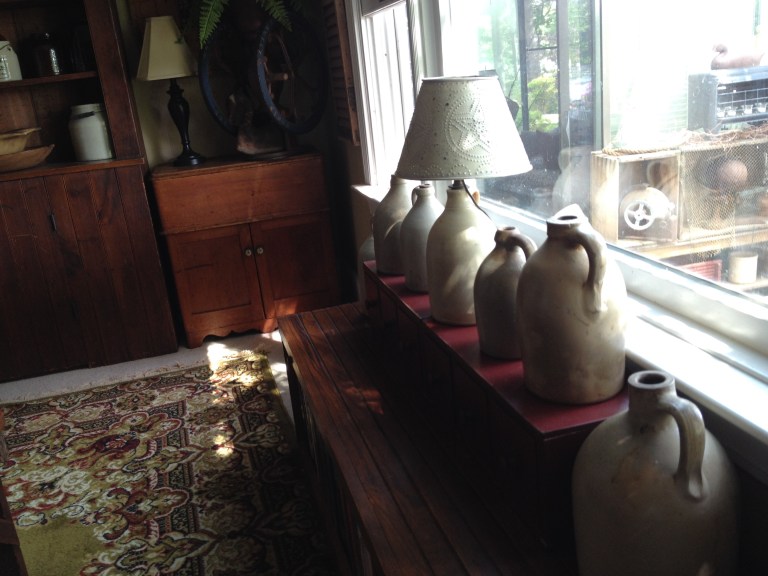
This week I’m going to present another theme-based series. For the next five days I will presenting a series of photos that feature a prominent use of various forms of stoneware crockery as decorating elements.
My home is filled with dozens upon dozen of pieces of stoneware. They vary greatly in color, shape, size, and functionality.
When Charles and I first begin collecting stoneware, the “perfect” stuff was cost prohibitive. So we got in the habit of looking for defective items. There may have been a chip on the neck of a jug, or slight crack in the base of a pickle crock.
But we wanted these items as part of our everyday decor, we were not interested in them as investments. So slight imperfections, or signs of real wear and use, were of no concern to us. In fact, we felt it added to the charm of the items, as it was a testament to the fact they were used on a daily basis in old homes throughout New England.
I will admit, I do enjoy finding jugs and crocks that are stamped with a potters seal. It adds to the fun of having the piece. Sometimes, it also is evidence that the item was made in this region.
If you take a peek around the room in this photograph, you’ll see various stoneware items beyond the obvious ones in the window. For example, there are a couple more on the shelf on the cupboard on the left side of the photograph.
Also if you look outside the window, on the primitive shelf that sits outside on our deck, there is a small crock on the bottom shelf. We have the stuff everywhere, it brings us joy. That pleasure comes from knowing that each of these items has a story to tell, of the hands that held it, of the contents that it held, and how it served the family who owned it decades ago.
If you like this photo and story, please share it with your friends with any of the buttons below.
-
It’s Not Really All Downhill from Here
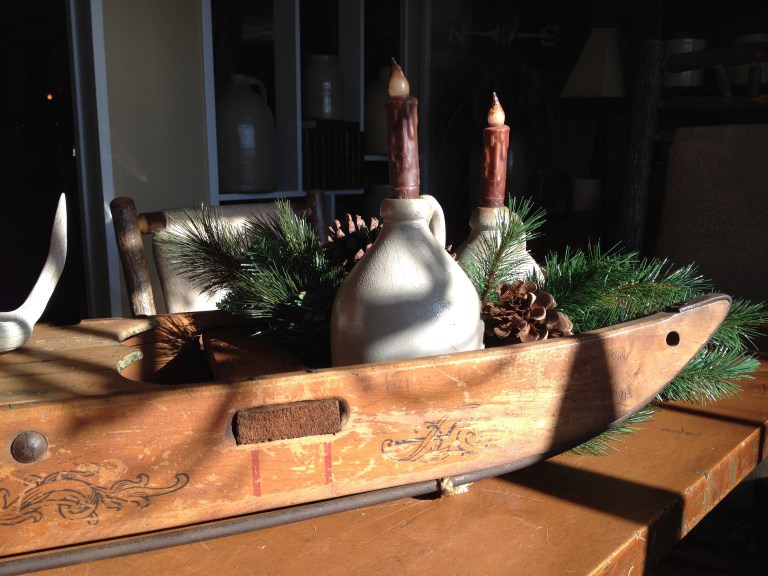
I love old sleds. Some seasons they sell like hotcakes, other times not. Some shop locations are great for moving them, others not.
As a result, there are times when I feel compelled to donate them to free up space in the basement for other things. I hate getting rid of these old relics of days gone by. You know, the olden days, when kids actually played outdoors. Unsupervised. And they didn’t die.
This sled is much more interesting than the old Flexible Flyers I’ve had. It’s hardwood, with steel runners. It weighs a ton. Honestly, I can’t imagine some little kid dragging this thing up a hill, with snow and ice encrusted in the runners.
Hey none of that matters. It now sits on my dining room table, decorated for winter.
If you like this photo, feel free to Pin it on your Pinterest.
-
Sunset on the Water
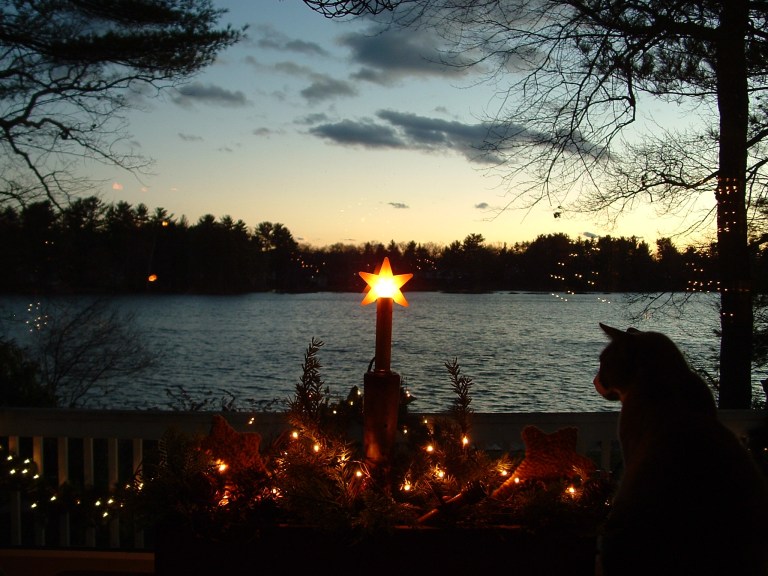
This morning we woke up to three inches of snow and a fierce wind. Chill factor was single digits.
But this photo captures one of our early winter sunsets a couple years ago, prior to the pond freezing and the snow flying.
This picture window is like a movie. The plot of the seasons is a captivating story, year round. Our buddy Boxcar loved this perch to survey his kingdom.
If you like this photo, feel free to Pin it on your Pinterest.
-
Baskets and Boxes
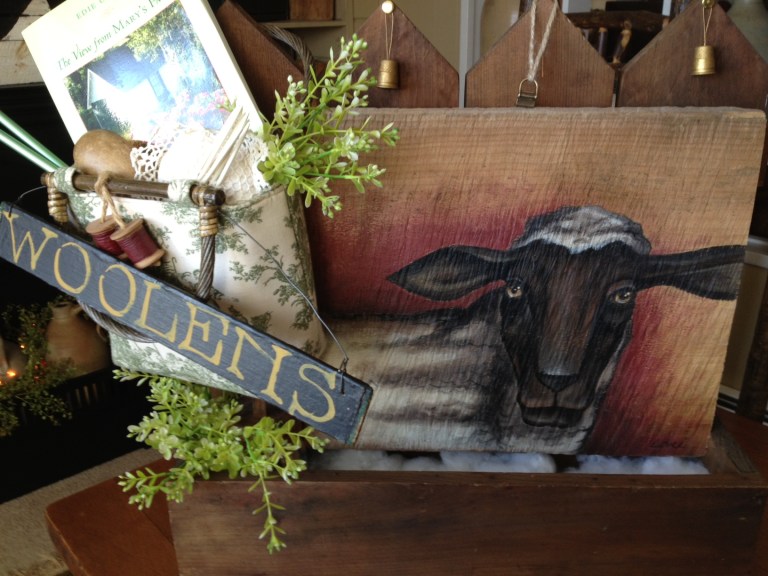
I was asked to whip up a basket for a raffle at the farm’s annual wool shearing extravaganza.
I only had a few days to do it, but I had some ideas that bucked the buyer’s expectations. I let her know I was thinking “Outside the Basket”, and she trusted me.
I had a small wooden box, that was just the right size for a little picket fence to be used as a backdrop. Next was the “Sheep”. This was a piece of folk-art, hand-painted on a rough-sawn piece of pine. I picked this up at a local antique shop.
On the pickets I hung a knitting bag, with needles, a darning ball and other related items. One picket was dedicated to holding up the folk-art and others for thimbles.
The box was a big hit, and it raised few bucks for the organization. I love it when everyone goes home a winner.
If you like this photo, feel free to Pin it on your Pinterest.
-
Pickin’ and Grinnin’

Some days are filled with surprises.
Recently Charles and I took a little trip north, to New Hampshire, to visit Log Cabin Antiques. Lynn told us about a barn sale a couple miles up the road. She suggested we check it out.
Charles whipped out his trusty iPhone and yelled at Siri a few times, before his digital guide correctly interpreted his accent, and gave us accurate directions. Of course we drove by the place three times before we found a hole in the stone wall, to get into the back field.

I like picking, Charles likes old barns. This one was built in 1750. I got a bunch of cool stuff, and Charles got to see how his white leather interior is not conducive to junk picking. I’ll buy him lunch and he’ll calm right down.
If you like this photo, feel free to Pin it on your Pinterest.
-
Chairs Are Not Just For Sitting
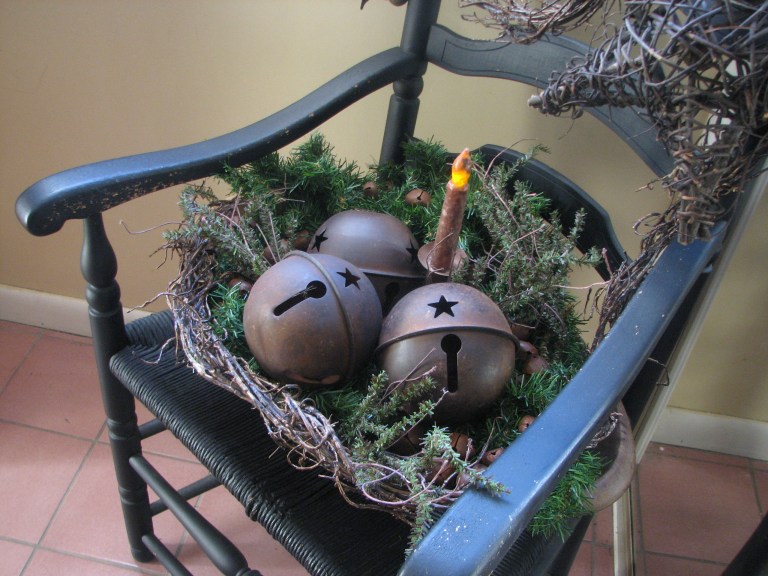
I have chairs every where. Sometimes I pair them up as Seating for Two. Other times I simply use them as a location to display seasonal vignettes.
Flat Black paint is my friend. I use it as part of my reclamation for old stuff, where wood has seen better days. This chair is sound, but the rush seating is not “butt-worthy” so it’s for decor only.
Rusty bells, Greenery, Vine Stars and a Candle, make this a welcoming feature in the entry hallway.
If you like this photo, feel free to Pin it on your Pinterest.
-
Faux Fireplace – Part 5
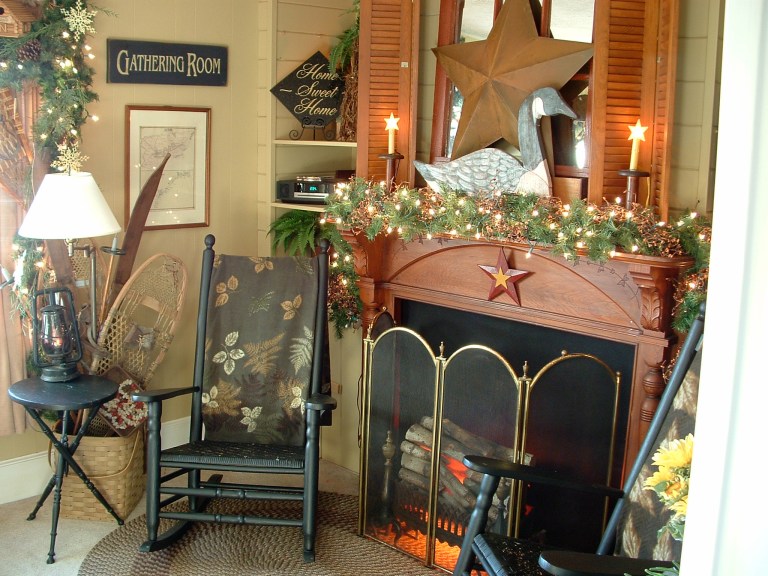
Faux Fireplace No. 5 has a long history with me and Charles. It was in the attic of our first apartment when we came home after Charles was discharged from the Air Force in 1973.
We liked the mantle and were told we could take it. It stayed in our basement in our first home for over 30 years. We dragged it to this cottage when we moved here over a decade ago.
One day, I noticed the space between these built-in shelves and measured it. It was a perfect fit for this old mantle. The andirons, grates, fake logs and screen were all rescued from the local dump, er, I mean transfer station.
If this scene look vaguely familiar, it is because this was the predecessor to the old pine fireplace from Monday’s post.
If you like this photo, feel free to Pin it on your Pinterest.
-
Faux Fireplace – Part 4
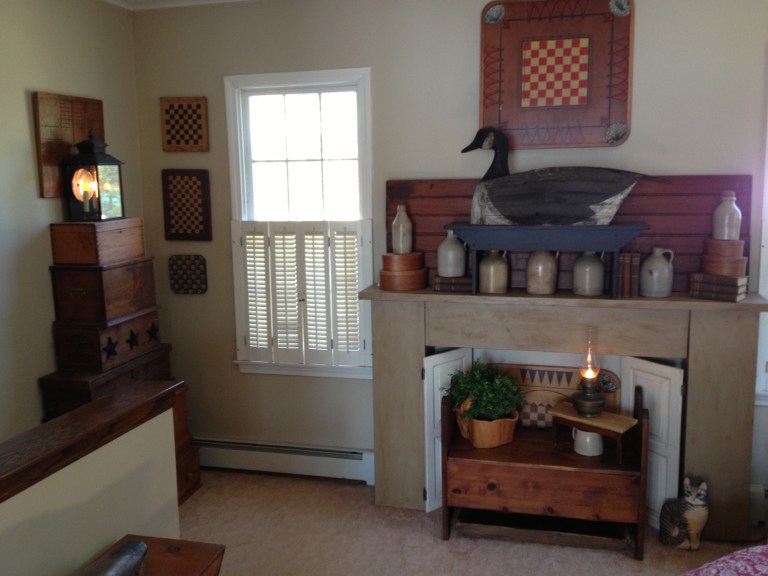
Faux Fireplace Number 4 is one of my favorites. It is the first one I had in the Cottage. Charles designed it specially for me for our entryway.
It is made from pine, in three pieces, so it can be broken down, moved or stored easily.
It is our good fortune that it fit perfectly between the windows in the sitting room of our Master Suite, considering it wasn’t made for this spot.


